Saturday, February 20, 2016

Radial JDV MK5 (VERY) Active Direct Box


Peter Janis
I have been a distant fan of Radial for years. I've never used any of their gear, but seeing it, reading about it and holding the occasional piece in my hands left me with one impression - very solid stuff. 

I saw the JDV MK5, read the cut sheet and asked Peter Janis if he'd forward one for this review. Peter was my "go to" guy when he was working with Gefell Microphones. I had heard that there was something special about the nickle-membraned Gefell M294, M295 and M296 condenser mics. Indeed there was. If you want to read that review, you can download it here.


Vintage imp-2
DIRECT BOXES
There are hundreds of them out there, ranging from my vintage Whirlwind imp-2 passive direct box, from the early 1970s, which consists of a couple of 1/4" jacks on one end, an XLR on the other and a small transformer inside. Direct boxes are used to convert a high impedance, unbalanced guitar or other instrument into a a low impedance, balanced mic signal. A transformer is used to correct the impedance mismatch. It also balances the line and sends it out as a three conductor connection; either on XLR or TRS. A balanced, low impedance mic level signal can run over longer lengths* (see notes at the end of this review). For the high impedance output of a guitar or keyboard, best practices says cables shouldn't be longer than twenty feet.

You still might run into problems even if you do stay within twenty feet. There are small mixers that say you can plug a high impedance instrument right into them. Yes, in some cases, but in other cases, the circuits are very unforgiving and the gain structure is wonky and you end up with "TCS", total crap sound!
Radial JDV Mk 5 front and back panels

Radial JDV MK
At $449, the Radial JDV MK5 is not passive nor is it your average active direct box. The 14-gauge steel used in the chassis and outer shell let you know this is just the tip of the iceberg.

The JDV MK5 has two channels, each with discrete, single-ended, Class A input circuitry, for electric or acoustic instruments.
It is decidedly not a stomp box unless you get  the JR-2 footswitch. 

Seen below, the two switches are for MUTE on the left and A/B select on the right. The JR-2 ($99) connects to the device using a standard balanced audio cable with choice of ¼" TRS or XLR connections. The JR-2 is unique in that it derives its power from the device being controlled which in turn illuminates the on-board LED indicators to show the remote.
Radial JR-2 Remote Control

According to Paul Blake, in the support department at Radial, these switches allow you to switch an instrument plugged into input one to either input A or input B, should you want to change the sound of your instrument for different parts of a song. The JDV MK5 would sit on an amp or somewhere nearby; close enough to plug in your instrument(s). You would not normally need to adjust anything on it during a performance.

The front/back image of the JDV MK5 above indicates that this is a busy box. There are two separate 1/4" TS unbalanced jacks, one for each input. Each input has its own input level control. Each channel also has a variable high-pass filter. The PHAZER knob and switch on the right allow you to time-align the two inputs. This would be for situations in which you had two pickups on the same instrument or a pickup and a strapped-on mic on the same instrument. The small switch below the knob lets you choose 0 to 180 degrees or 180 to 360 degrees. You then use the knob to align the two signals before the mono balanced XLR and other outputs. The other front panel adjustments are for compensating for different kinds of pickups. 

JDV MK5 Front Panel
Front Panel
Input A has a switch that changes the input impedance from 10 M Ohm for piezo systems to continuously variable DRAG for magnetic pickupsThe continuously variable resistive DRAG control allows you to compensate for the load from 22K Ohm to 500K Ohm for passive pickups. Input B can be switched from 10 M Ohms for piezos to 220 Ohms, typically for magnetic pickups

I have a K&K Pure Western Mini (now called a Pure Mini) piezoelectric passive pickup installed in my D28S Martin, thanks to the gentle and intelligent hands of John Thurston before he abandoned Baltimore for an obviously better way of life at Guitar Tex, in San Antonio, TX. This is a great pickup choice for that guitar, especially for finger-style playing, because there's little if any quack. 

The Pure Mini is three electronically paralleled piezo pickups mounted inside on the bridge plate. According to K&K, it wants to be plugged into a 1 Meg Ohm or higher input. Straight into my Fishman SoloAmp, it sounds better than I thought it would. I was curious about the Fishman SoloAmp 1/4" instrument input so I reached out to Derek Alves in the support department at Fishman. Alves confirmed that the input impedance of the 1/4" input is 5 Meg Ohm, so good to go for plugging straight in, but what about through the JDV MK5 and out its XLR to the Fishman SoloAmp?


I plugged the Martin into input A of the JDV MK5 and began to turn the drag control which requires a screw diver. The thought being that once you get it set, you don't want to accidentally change it. The D28S isn't as boomy as a regular D28, but it's still quite full. I found a position fully clockwise with the DRAG control - so, 500K Ohm, and about mid-point in the rotation with the high-pass filter that tucked in the bass a bit and the sound was more "finished", with a broader, flatter frequency responseAt this point I was coming out of the JDV MK5's XLR out and into the SoloAmp XLR input. Nice!  

I expected more of a difference with tonality when adjusting the DRAG and other impedance switches. With my guitars the effects were very subtle. Regardless, the difference was mostly about gain. Full clockwise (500K Ohms) on the DRAG control was best; YMMV with different pickups. 
Turns out, if you have piezo pickups, you should stick with the 10 M Ohm input positions on the JDV MK5. The DRAG control was designed more for magnetic pickups. 

The effect of the high-pass filters were more noticeable. None of my guitars, the Martin D28s, Fender Thinline with humbuckers or Martin Grand J28-LSE Baritone with active electronics ever got close to exceeding the input level and I had any guitar and JDV MK5 gains turned all the way up; so plenty of head room.

JDV MK5 Back Panel
AROUND BACK
The back of the JDV MK5 is no less busy. There's a four pin locking XLR to bring power to the unit from the external power supply. 

The next connection is a balanced 3-pin XLR fed from a Jensen JT-11-YMPC transformer, designed to feed a live sound board or recorder. 

The next four controls grouped together under the Radial logo offer some savvy help. The first one flips the polarity 180 degrees. The second one lifts the ground on pin 1 of the XLR output. The third one inserts a Jensen JT-11-YMPC transformer to isolate the XLR output signal path. These two may help you deal with your good friends Hum and Buzz. The fourth bumps the JDV MK5 output up to +20 line level. 

Continuing across the back panel are the jack for the footswitch that allows muting and switching between the two channels and an always-on 1/4" unbalanced, high-impedance out that can feed a tuner, amp or other device. There are two 1/4" unbalanced instrument inputs, one for each of the two inputs. There's a separate 1/4" unbalanced THRU output normally used to feed a stage amp and a separate 1/4" balanced TRS jack for microphone inputs. 
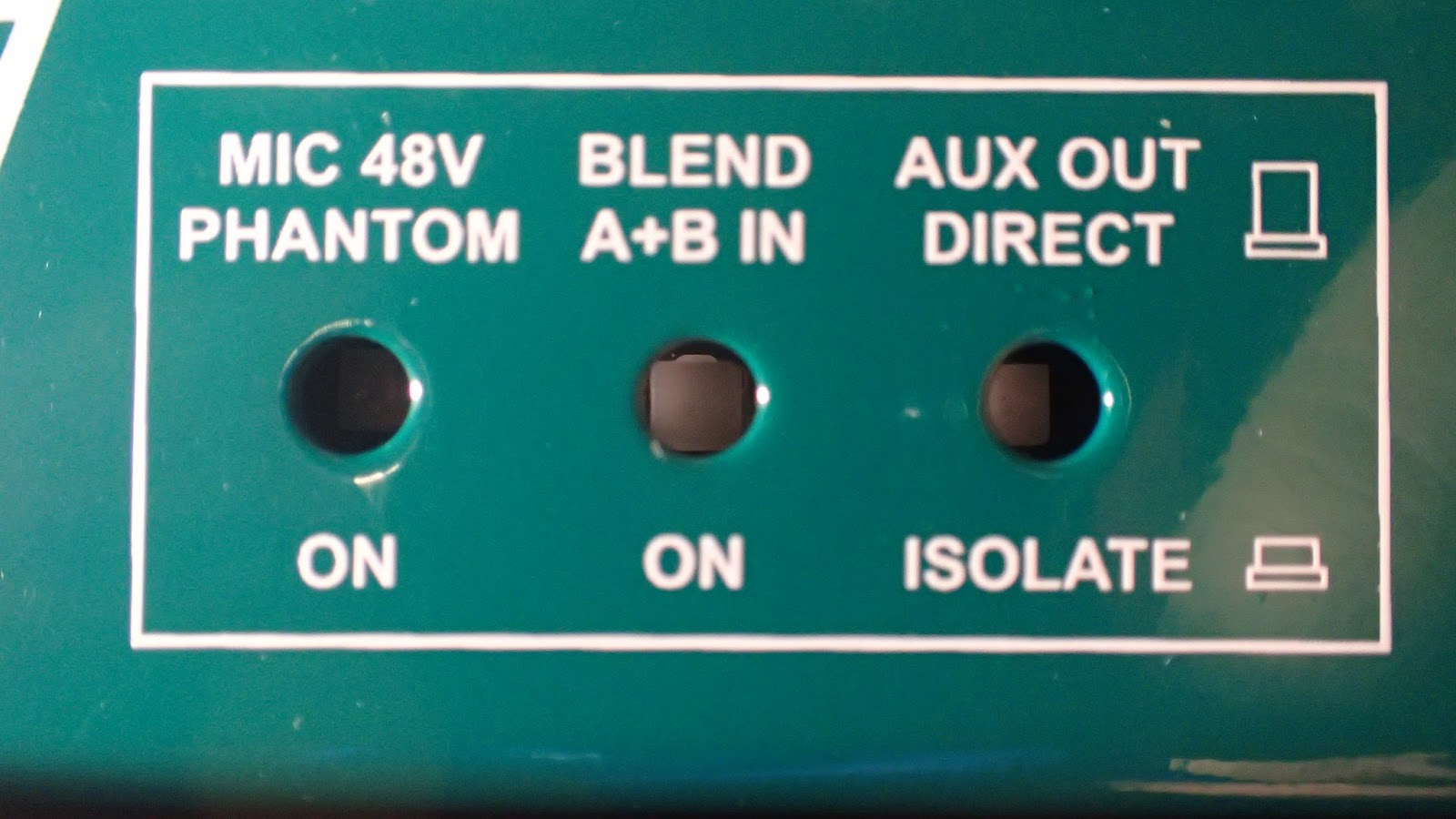
PHANTOM POWER
The 1/4" TRS microphone input jack is only routed through the input A. It has 48 V Phantom Power. According to Blake at Radial, "With phantom power, the two 6.8K ohm resistors limit the current to phantom powered devices to 10mA." That's more than enough for the hungriest condenser mic.

An LED under the DRAG control on the front panel lights when Phantom Power is active. As a safety precaution, the Phantom Power turns off when the JDV MK5 is powered down and has to be re-engaged by the small push switch in the side panel upon power up.

Both my Neumann TLM 103 (23 mV/Pa) and Audio-Technica AE5400 (10.0 mV/Pa) condenser mics overpowered the mic input when worked any closer than a foot, lighting the O/D lights on the front panel. Engaging the 10 dB pad on the AE5400 dropped the signal below clipping. I really like the Audio-Technica AE5400 for live vocals. I reviewed it back in 2003 when it came out. It uses one half the capsule of an AT4050 and has a 10 dB pad and high-pass filter. I'd put it up there with a Neumann KMS 104 and KMS 105. If all you have is high-sensitivity condensers with no on-board pads, I guess you could add a pad to the mic cable. My Shure SM86 (3.15 mV/Pa) hand-held condenser worked just fine with no pad, requiring the input trim to be about halfway up at 12 o'clock. My vintage dynamic Sennheiser MD421 (2.0 mV/Pa) also did well, also at about 12 o'clock. 

I was easily able to plug a mic into input A and my guitar into input B, control the levels with input trim and alter the frequency response with the separate high-pass filters. Everything sounded just fine at mic level going into my Fishman 220 SoloAmp. I could have also chosen the +20 output on the side of the JDV MK5 and gone line level for recording or to a FOH console. 


DEEP INSIDE
Drilling down a bit more into the guts of this beast. It's very common to use negative feedback in a circuit to improve fidelity. Negative feedback is not the only way to go, but it's a very common way. The Radial JDV MK5 does not use negative feedback and achieves its performance with single-ended Class A circuitry. Class A circuits are usually less efficient, generate more heat and exhibit better high frequency performance and fewer higher-order harmonic problems. Here's a great rabbit hole about amplifier modes.

Radial bought Jensen in mid 2014, so they now own one of the best makers of audio transformers in the business. Bill Whitlock, the former President, said Radial was their biggest client and in as much as he was turning 70, he wanted to ensure that Jensen's good name would continue. Quality transformers may not seem to be that essential, but they are a very big deal. 
A little bit of finely-crafted iron can really smooth the edges of your audio. 
 
John Hardy

John Hardy makes high-quality mic preamps, including one of my all time favorites, the Jensen Twin Servo, and knows quite a bit about Jensen transformers and circuit design. "Most traditional audio transformers use core material that is 97% iron. Most of the Jensen transformers use core material that is 80% nickel. I know that "iron" is a commonly used term when referring to transformers generically, but I like to make the distinction that the best transformers use the 80% nickel core material. Nickel is much more expensive than iron, but it performs better."  (and there we are, back at the magical properties of nickel. More about nickel here)

Being able to consistently and accurately turn out great transformers is very important. Hardy says. "Early Jensen transformers were wound by Reichenbach engineering. They were good, but Jensen is now winding in-house with more precise winders, so the piece to piece consistency is even better."

IN CONCLUSION
I found the JDV MK5 to be a very well-made and versatile piece of gear. It does a lot of different things and could be expected to become the hub of a performing musician's cluster of gear. The solo performer could use it to simply control one vocal and a mono instrument to one mono output, or other more complex configurations. Please continue to scroll below the specs for more information.


Addenda

2/20/16: Just before I returned the JDV MK5, I noticed a strange little noise on the ring out of notes on input B. I sent word and an audio file to Ryan Juchnowski, Custom Shop Manager / Trade Show / Radial Technical Support. He said this was unusual and would get back to me. Keep an eye on this space for an update!

3/1/2016: This is what they had to say; “We had engineering test a few of the units off the shelf and found that sometimes, when the signal LED begins to dim/discharge, that the strange noise becomes present. Luckily this is an easy fix and we have changed the resistor values in all new units so that this intermittent problem has been eliminated. Should users find that this issue is present in units which they already own, all they need to do is contact customerservice@radialeng.com and in typical Radial fashion, they will be taken care of immediately.”


JDV MK5 SPECIFICATIONS


SIDEBAR

Hold on a minute! There is documented evidence that even running long mic level signals back to FOH mixers also results in signal degradation. Fortunately, the JDV MK5 can also run +20 line level. 

Years ago, I spoke with John Hardy for a review in MIX magazine. He recounted events at which Randy Ezratty's Effanel remote recording rig was used to record major concerts. They found that they got a better signal in the truck if racks of mic preamps were put on stage. Makes sense, right? Shorter mic to preamp runs sounded better than long mic runs. (Yes, they had to have an extra tech stage-side to oversee the mic pre levels.) The take away lesson was that if you're running long lines, it's better to have them at line level than mic level. 

Even if you do this in live sound, your mixer and speakers may not be good enough to let you hear the difference. I walked into a singer-songwriter event here in Baltimore one night and noticed an AKG C1000S set up for acoustic guitar. I thought the sound would surely suck, but to my great surprise it didn't!

I'm guessing that the PA company owner hadn't had his C1000S modified. It must have been the compromises of the PA system that scraped the edge off of the C1000S. If you have one, try it in the studio and for live PA and see for yourself. If you have an AKG C1000S and are in search of a mod, try Mark Fouxman at Samar Audio. Last time I checked, he was charging $169 USD for the mod. 

Hey, please subscribe to this blog. There are links up top on the right side for that. If you have questions......ASK!

Technique, Inc. © Copyright 2016 
Reach Ty Ford at www.tyford.com


Tuesday, January 19, 2016

Samson XP106w Battery-Powered PA with 2.4 GHz Wireless and Bluetooth


Reach Tom Blair at tb.blair51@gmail.com
Tom Blair, a good friend and client near Baltimore, called asking for some live sound/audio help.

In addition to writing, directing and producing a wide range of theater and video projects for his own clients, Tom spends most of the 4th quarter of every year playing Santa Claus at shopping centers, malls, gatherings and private parties. He may not traverse the globe in a sleigh, but he's become the local "go to guy" for Holiday Cheer.

That's a real beard and his costume is very upscale. 

Tom told me that recently he's been addressing groups of 100-200 people. Some of these venues may not have a full-time media wizard on hand to provide a mic or operate a PA. What Tom wanted was a self-contained system that would allow him to roll in, set up and go, without even using an AC outlet. I had seen some enterprising street musicians with small battery-powered speaker systems, but really hadn't had time to check any of them out.

Samson XP106W System w/Handheld Wireless Mic
I went to the B&H web site and searched for Portable PA System. The Samson XP106w looked promising and as a B&H Affiliate, I had one forwarded here. There were several things that appealed to me. 

It's sparse but also full featured
It weighs only 21 pounds
It has a two-way speaker system
The amp is 100 watts
It has four inputs
It has a 2.4Ghz USB dongle
It has Bluetooth
There's a balanced Aux out


Samson Stage XPD1Headset USB Digital Wireless System
Tom wanted hands free operation so even though the XP106w comes with a wireless hand-held mic, I also ordered the Samson XPD1 2.4 GHz wireless USB headset It's designed to work with the XP106w. 

It's a very simple system. To pair the transmitter with the USB stick receiver, you plug the USB stick into the USB connector at the third input on the back of the amp, power the amp up and push the pair button on the USB stick until it blinks. Then press and hold the on button on the wireless mic pack until the light stops blinking. 

Technophobes Pay Attention: You only need to do the above once. You can turn the system off, take the batteries out of the transmitter and when you put them back in and power up the amp and mic, the connection is restored. When the mic is turned on, it works.


Tom mentioned that he was working on a new character for a one man show. As he envisioned it, he might have some pre-show music and maybe a show starter to announce him before he came on stage. I hadn't really thought about that, but looking at the back of the XP106w, I noticed that the fourth input was for Bluetooth. 

There's a pair button on the top of the amp by the handle. Press the button. It blinks. I started Bluetooth on my MacBook Pro and it found the XP106w. I selected that and in about five seconds the audio from iTunes on the Mac was playing from the XP106w. I had to reduce the output of the laptop a little to get the best sound and to be able to turn the XP106w pot up more than "barely open." I was very impressed that the system operated so easily.

Input 1 has a combo XLR-1/4" connector, no Phantom Power. 
Input 2 has a mini 1/8" TRS jack and a 1/4" jack. 
Input 3 has the USB 2.4 GHz digital input.
Input 4 has the Bluetooth input. 

There's a push button for music/speech. In the speech position some of the low end is rolled off. 

The battery is a rechargeable Lead-Acid battery that claims up to 20 hours of use on a charge. There's a plug in power supply/charger. You can run on AC power or charge the battery but not both at the same time. With the power off, if you plug in the power supply a red LED lights on the back panel to indicate the battery is charging. When the battery is fully charged, the LED goes green. This is not a quick charging system. Plan ahead and you'll be fine. The manual also says, after use, charge the battery fully before you store the XP106w. The battery will slowly discharge, so you will probably want to recharge it again before using it.
Auray SS-4420 Steel Speaker Stand

I suggested to Tom that he get a good support stand. I found a sturdy tripod on the B&H site, the Auray SS-4420 Steel Speaker Stand, that holds up to 100 pounds. Maybe overkill for a 21 pound amp, but I hate wobbly support systems. You're only asking for trouble. The XP106w has a mounting hole in the bottom that slips right over the mast. There's a steel pin that goes through holes drilled in the mast to keep the mast from collapsing into the base.

IN CONCLUSION
As I was working with the XP106w, I thought about my imaginary life as a street musician and how much better it would be if I had this rig to be out there busking. Or for impromptu political rallies for the upcoming election. You could easily plug a guitar or any other instrument in and go for it. Wish my original Pignose was so well equipped.

© Copyright 2016 All Rights Reserved
Reach out to Ty Ford at www.tyford.com

Hey! Please subscribe to this blog!

Wednesday, December 30, 2015

Audio-Technica BP40 Large Diameter Dynamic Mic


Audio-Technica BP40 Dynamic Microphone
When I first saw the new Audio-Technica BP40 dynamic mic, I thought, "Hmm, looks like the love child of a Shure SM7 and an Electro-Voice RE20. A little longer than an SM7, but with a grille more like an RE20 or RE27N/D.

Large diaphragm (1.47") , hypercardioid pattern, humbucking coil, 6 dB/octave 100 Hz low frequency cut, integral pop filter, relatively high sensitivity - –48dB (3.9mV) re1V at 1 Pa, 450 Ohm impedance, 50-16,000 Hz frequency response, less than 1.5 pounds.

BP40 Capsule
Got it;
- diaphragm bigger than most LD condenser mics
- tight pattern

Looks like an on-air mic with kick drum possibilities. $349 on the street, which is about $100 less than an RE20.

On-air microphones have to handle close talking announcers, so stopping pops is essential. The BP40 has a 3/4" thick, replaceable foam pop stopper seen in the photo below. I unscrewed the headgrille and shot the below photo aimed back up towards the back of the foam.

Inside the BP40 Headgrille
Having a replaceable foam pop stopper is very useful and healthy, especially in radio stations where a cold can be quickly passed from person to person as they nuzzle the mic and change shifts. The BP40 headgrille simply unscrews, allowing you to change the foam and disinfect the headgrille. The headgrille also serves another purpose, it keeps the talent at least a specific distance from the diaphragm to prevent closer and more proximity effect from overwhelming the almost inch and a half diaphragm.

Radio DJs frequently like to "eat the mic" to take advantage of the bass building proximity effect that getting close to a directional mic produces. Working close also reduces bad room acoustics and noisy HVAC systems. Let's move to video for a comparison between the BP40 and RE27N/D.


In the above video shot in my studio, you can hear that the the pattern is tight as the graph below left indicates. There's a slight tail at 5kHz, but when you listen to the above video, while you might be able to hear it a little more than with the RE27N/D, I don't consider it a problem.

The BP40 has a humbucking coil to reduce the pickup of stray AC fields. I have an "AC Hum Hell Hole" in one spot here in the house. It's really tough on mics. especially ribbons and dynamics. There's a 200 amp AC service cable that runs down the outside of the house to the main panel in the basement. Inside, in my den, some mics begin to pick up the hum as far away as three feet from that wall. I got the BP40 all the way to the wall before I heard the faintest hum.

BP40 Polar Pattern
BP40 Frequency Response


My first career was 17 years in radio as an on-air talent and Production Director. That's a lot of time on mic; a five hour air shift and at least three hours of production, five days a week. Different stations have different mics. Your voice becomes a test tone. You learn a lot about mics. If you're still in radio production and have somehow missed Radio And Production magazine, check it out. Editor Jerry Vigil has been working hard for quite a few years to make RAP an oasis for radio production people.

Depending on the voice and delivery, you learn to use the variable frequency response caused by working the proximity effect of the mic. Above right, the frequency response graph of the BP40 works well for voice; the frequency response graph shows a nice little peak at just below 4 kHz. The 6 dB per octave bass cut shows the roll off begins at 200Hz. Again, in the above video, you can hear the effect. You may well need the Low Cut for big voice performers who like to eat the mic. Not a big voice? Then leave the Low Cut off and move in.

WTMD
WTMD Ops and Tech Manager Donnie Carlo
In order to get a wider scope on what the BP40 sounds like, I reached out to Operations and Technology Manager, Donnie Carlo, at WTMD. Carlo arranged to have me come in to the WTMD studios and also mentioned that one of their female air talent could help me by cutting some tracks. Carlo had an ElectoVoice RE27N/D and a Shure SM7 lined up for me. These are typical on-air mics. Perfect!

WTMD is a college station, attached to Towson University, but it's no ordinary "college radio station." Their programming and listener outreach is the best I've heard and seen. We're very fortunate to have them here in Baltimore. It's a Class B1 FM at 89.7 MHz with a power of 3 kW. Several years ago they received a grant that allowed them to move from the basement of one of the older university buildings to a new facility at 1 Olympic Plaza in Towson, MD. It's a beautiful facility with updated gear. I know many professional radio people who have never worked in a station as sweet as this.

She who will not be named @WTMD
We spent about an hour in Studio C using my voice and the voice of "the female talent who preferred to be unnamed" - how's that for mystery!? We recorded with the Audio-Technica BP40, Shure SM7 and ElectroVoice RE27N/D with the top EQ roll-off. I also recorded my voice back here at my studio using GML preamps and an RME ADI-8 DS A/D converter interface.

I found that, as with the RE20's Variable D design that minimizes proximity, the BP40 proximity effect didn't really kick in on my voice until I was two inches or closer.

Peavey International II kick and BP40
Drums
I had a music session here and used the BP40 on kick drum. I wasn't sure how the ten year old Peavy International II kit would sound. The kick is a 22" x 14", 9-ply basswood drum. (to the right.) I was very pleased by the the entire kit and the kick drum. The extra barrel with yellow label is a Shure A15AS variable pad set to -15 dB. The kick drum track below says more than my words can. See what you think.

Here are some files to check out. I think the BP40 holds up very well against these mics.

Ty Ford Voice BP40 w/GML preamp

Ty Ford Voice BP40 at WTMD

Ty Ford Voice RE27ND (with peak cut)

Ty Ford SM7 at WTMD (cover removed)

Female VO talent BP40 at WTMD

Female VO talent RE27ND at WTMD

Female VO talent on SM7 (cover removed)

Peavey International II Kick drum

In Conclusion
Like most Audio-Technica mics, the build of the BP40 is very solid. Having a quality, directional hypercardioid like the BP40 in your mic locker will serve you well. Based on my use of it, I'm guessing that it would work or horns, hand percussion and guitar amps as well. It would also probably tame banjos and fiddles.

Copyright 2015 All Rights Reserved

Contact Ty Ford at www.tyford.com

Saturday, December 19, 2015

AES NYC 2015 A Journeyman's Wandering #05 & Finale


Photo by Tom O'Connor
The AES/NYC show at the Javits Center (or in California on even years) is always an eye and an ear opener. Each time I attend I come in the door thinking I've pretty much seen everything. I'm always wrong.

From the white papers in sessions where engineers talk about what may be around the corner to the floor where you can see what's shipping or what's about to ship, my coverage continues with this 5th and last episode. 

Read on, there may be surprises for you. This last report features RME, Radial Engineering, TASCAM, Lewitt Microphones, Zoom Recorders, Cloud Microphones and from Shure, in-ear monitors and MOTIV, which offers digital microphones and new ways of recording. 
RME
I have been an RME user for about eight years. I bought one of their A/D D/A converters because I wanted to improve the audio quality going into my Digidesign 003r, rack mounted I/O box that I operate using Pro Tools. I still use the original RME ADI-8 DS for that job, even though RME has upgraded it to the RME ADI-8 DS Mk iii. If I needed that same sort of quality functionality today, the Mk iii would definitely be a contender. I reviewed the new unit in February of 2015 and you can find that review here. The combination of my room, mics, preamps and the RME ADI-8 DS, are responsible for the quality of the sound I get.

I was looking for a piece that would be attractive to small studios and also for actors who are called upon to do their own engineering when asked by producers for voice auditions. The audio book market continues to grow and the tech-savvy actor can open an account at www.acx.com and make at least a partial living by recordings book in the privacy of their own homes. 


The RME Babyface Pro (above) is one way to get there. Its small footprint belies its abilities. As I watched Jeff Petersen explain the ins and outs, it occurred to me that there was a lot going on inside this box. I'm sure you'll agree!

Radial Engineering
I have always enjoyed the thinking at Radial Engineering. They make a large number of audio boxes that do lots of different things - call them "problem solvers" if you like. You'll understand as you watch Jay Porter explain some of these boxes, like the BT-Pro, the first BlueTooth enabled stereo receiver direct box. The DI Net, direct boxes for DANTE systems that either input or output from a DANTE network. The JDX Direct-Drive a small instrument amp simulator that lets you feed a small house system or a small powered speaker, but the processing in the box supposedly makes it sounds like a Marshall 412……except at a much lower volume and without having to lug the amp in and out. Check them all out in the video below.


Radial bought Jensen a few years ago. John Hardy has been making the one rack space Jensen twin 990 servo preamp for some time and it's a truly great sounding preamp. I've had one here in my studio and also took it around to other music studios to the delight and amazement of others. For more details, here's a rabbit hole to my online archive and one of the reviews I wrote about the Night preamp and the Jensen twin 990. The Jensen twin servo mic preamps built into the 500 Series format caught my eye and ear.  

Jay also had a nice USB-Pro Stereo USB Laptop DI box (below) that can solve a lot of problems. 

TASCAM
TASCAM's Jeff Laity had a great little plug on recorder for dynamic mics, the DR-10X Plug-On Micro Linear PCM Recorder (below). If you're doing on the street reporting with a dynamic mic, you can now safely leave the cassette deck behind. This would probably be useful for singer-songwriters or anyone who want to quickly capture a mono file of a thought or musical performance. Keep one by the bed for those wake-up moments when you have a great idea that you'll never remember in the morning.


On the top end, TASCAM's DA-6400 is a 64-track recorder (below) for live sound, FOH or live broadcast recording and playback. Timceode, Gigabit Ethernet, Serial RS-422 and parallel control.


TASCAM has speced and engineered their own SSD hard drives and have hot-swappable enclosures for them. There are two I/O slots for optional audio interface cards: IF-MA64/EX 64-channel redundant (in/out/thru) MADI optical/coaxial interface card, IF-MA64/BN 64-channel MADI coaxial interface card, IF-DA64 64-channel Dante interface card and an IF-AE16 16-channel AES/EBU interface card.

Lewitt Audio
To be honest, I had never heard of Lewitt microphones. They started after Roman Perschon left his job as Project Manager for AKG, best I can tell, around 2009. Lewitt makes a line of dynamic and condenser mics. I wish them luck. It's a crowded market. The glowing vacuum tube in the Lewitt LCT940 (below) caught my eye and the power supply and pattern adjustment box it was attached to looked interesting, so I spent a few minutes with Dean Downey to learn more. It's a mic that combines both FET and tube and allows you to vary the mix of the two and choose among all the patterns from Omni to Figure Of Eight.


ZOOM
I've been a fan of Zoom for a while. They have made inroads into the pro audio and pro video markets with low cost gear that has some limitations, but gets the job done. I have reviewed both the Zoom Q4 and Zoom Q8 video cameras and am amazed that they can bring the technology they do at the price points they do.


I saw the Zoom F8 (above) come out earlier this year and have heard that it's selling very well. There are some cautions. The knobs are pretty difficult to mix with because they're so small. Also the gain knobs turn down, but not completely off. So the ideal use for the F8 is for a multi-track ISO recorder that you'll use to record audio and then mix the ISO tracks in post. Check out the new iPad control that Charlie Lederer demonstrates. Very Cool.

Cloud Microphones
I've known Roger for about five years. I reached out to him when the Cloud  JRS34 bi-directional ribbon mic came out. I worked with Cloud to make a few changes in the JRS34 as they were getting it ready for market. 

Somewhere along the line they put out a small amp stage called the Cloud Lifter. Then the Cloud Lifter CL-Z variable impedance mic activator. It's a truly neat device, especially if you have passive ribbon or dynamic mics, even a Shure SM57 or SM58. (Non-linear thought: If you're micing a snare with an SM57, try a Granelli G5790. It's an SM57 with a 90 degree angle that's a lot easier to position on a drum kit. These are local Baltimore guys.) The Cloud Lifter CL-Z allows you to continuously vary the impedance load the mic sees. That, of course, changes the sound of the mic; more flavors, more colors.


Shure
I've never seen so many in-ear phones! I asked Shure's Thomas Banks to run down the list and explain the differences. The Shure booth was very, very busy. I was concerned that all of the chatter around us would cover our comments. It's a little tough, but work with me here!


The Shure line (above) was very impressive. From the SE112 ($49), SE215 ($138.99), SE315 ($242.99), SE425 ($342.99), SE535 ($499), SE846 ($999), SHA900 listening amplifier ($999), and KSE1500 electrostatic earphones ($2,999.00) - there's a price point and feature set for everyone. (really? $3k? What must that sound like?)

My first thought was that one of these many in-ear drivers would be perfect for videographers who are also responsible for grabbing sound. Their problem is that even the small-ish Sony MDR 7506 headphones stick out too much and bang into the side of the camera when it's shoulder-mounted. NOT HELPFUL!! I hope to get around to trying some of these later to find out which model delivers sound similar enough to the MDR7506 to be useful in the location audio work I do. 

If you think Shure has been sitting on its laurels and watching the world go by, THINK AGAIN! This became apparent when Banks gave me a whirlwind (pun intended) tour of the Shure Motiv line of digital mics and new recording solutions. Please excuse the couple of places my camera decided to go soft focus. I may have had my finger over a focus sensor. I need to look into that. 


Banks showed me the Shure MVL lav, MV5, MV51, A free Motiv App, (a 24/48 recording software - check the App store), the MVi, MV88 Mid/Side stereo condenser with an amazing amount of control via the App in the above video. With these, Shure has definitely demonstrated that it's listening to "what the kids are saying."

That was my last stop of the second day and as the sun set over Manhattan, I walked back to the once grand (but not any more) Hotel Pennsylvania. OTOH, the Niles Restaurant a block south on 7th Avenue in the Affinia Hotel, was a great place to eat and drink.

The next day, as we trained from NYC back to Baltimore, I could only say that the AES Convention was, once again, great and showed me more than I expected. 
  

Tuesday, December 8, 2015

AES NYC 2015 A Journeyman's Wandering #04


This fourth report from AES/NYC 2015 moves on to cover more of the booth visits I made over a day and a half. I took a small Olympus Stylus TOUGH TG-4 Digital camera with me so I didn't have to take notes and because "reality video" catches a bit of what it feels like on the floor. It's has a 16MP BSI CMOS with a top sensitivity of ISO 6400 and a 5 fps shooting rate at full resolution. 

I got it over the hundreds of others on the market because it's built to withstand underwater dives to 50 feet, falls from as high as seven feet onto what I don't know), temperatures as low as 14 degrees fahrenheit and pressure up to 220 lbf. I wasn't expecting to operate the camera at any of those extremes, but thought being prepared might come in handy later.

I used it in auto mode most of the time and, while not perfect due to operator error and the whims of the camera itself, I was and remain happy with it. The "stereo mics" are mounted exactly where my left hand wants to hold the camera, so I had to learn to hold it somewhere else our all you could hear was mmmfmmmmfmfmmfmfmmff.

Zaxcom
Glenn Sanders is relentless in his efforts to improve location audio gear. First in many things, the Zaxcom "firsts" that stand out for me are a small, digital body pack transmitter that has a built in audio recorder and also records time code to a mini-SD card, NeverClip, a system that prevents overloading of the transmitter by unexpectedly loud sounds and the ZaxNet systematic approach that, among many other things, allows an operator to adjust the sensitivity of a transmitter from a Zaxcom console without ever touching the transmitter itself. Click on the Zaxnet link to find out more.


Join Glenn above as he talks about the new Nomad Touch Remote control. If you're doing location audio from a bag or on a cart, the Nomad Touch can let you take care of business very easily; metadata, changing output busses, record enable tracks. So it's a Deva-style touch screen for a Nomad recorder. Nice!

Rycote
Scott Boland was at the Redding audio stand and among other things was showing the new Rycote Cyclone windshield kit. The system is different in that the windscreen itself is attached via a suspension system to the base. That reduces vibrations from making their way to the microphone. Scott is showing a medium sized vernon in the video. It works with a Sennheiser 416Schoeps CMITRode NTG1NTG2 or NTG4 or 4+. As of 12/7/15, the only size available in the USA is large. That would be the right size for long shotgun mics like a Sennheiser 816 (If you still have one), Audio-Technica 4071L, or a Rode NTG8. Shorter versions are expected in 2016. Check out Scott's demo below.


Earthworks 
Eric Blackmer was just across the aisle at Earthworks. It had been some time since I had talked to him and we did some catchup, especially on an ingenious invention called a KP1 KICKPAD, an inline device that allows almost any XLR terminated mic to be used as a kick drum mic. $99.

It comes with the Earthworks DK25/L Live Performance Drum Mics that also includes three SR25 cardioid mics and a windscreen for the kick drum for a simple but effective three mic drum PA setup. 

There is also the Earthworks DK25/R Recording kit that includes two TC25 omni mics for overhead, a SR25 cardioid for kick, a KP1 KICKPAD and a windscreen.


Finding solutions for situations is vitally important for any company. The Earthworks FW730 FlexWand mics and stands are good example of this approach. Preachers, drummer and choir directors take note as Blackmer details the applications and why the FW730 works so well. I like the fact that it has an XLR plug built-in to the stand itself and the cord runs internally all the way up to the microphone. And as Eric demonstrates below, it's very stable.


Finally, Blackmer showed me the Earthworks SR20 handheld cardioid condenser for live work that can withstand 145 dB SPL. I was struck by the ingenuity of Earthworks designers to come up with the screw on headgrille that allows one of his typical designs to be repurposed for a totally different application. Very cool! $599 is certainly out of the reach of anyone with an SM58 budget. It's up there past an Audio-Technica AE5400 and equal to a Neumann KMS 105but mics are sometimes something you don't know you want until you hear what they do. Then you want one! See what Eric has to say about the Earthworks SR20 below.


Coming up in the next edition, the RME BabyFace Pro, a long list of Radial Engineering gear, a new Tascam plug on recorder plug on for dynamic mics, a Tascam 64 track recorder with removable hard drives, a new soft, silicon surfaced Roli music keyboard, a gaggle of Shure in ear monitors and more! Keep an eye out! Subscribe to the Blog!!!

Copyright © 2015 Technique, Inc. All Rights Reserved.

More at www.tyford.com