Monday, November 23, 2015

AES NYC 2015 A Journeyman's Wandering #03


Gateway to the AES Show Floor
The 2015 Audio Engineers Society Convention in NYC comes to the Javits Center every other year. It bounces from the East Coast to the West Coast every Fall.

The display floor is part of the show. There are also suites in which closer listens to particular gear are available, and a healthy collection of papers and presentations are made. If you're in pro audio, keeping track by being a member of AES can be helpful.
Doug Fearn AES 2015

D. W. Fearn
I got in mid-day friday and spent the remains of that day on the left side of the hall, seeing old faces and meeting some new ones. Doug Fearn is one of the old faces. He's has been making hand-crafted analog mic preamps, compressors and EQ for about fifty years. His web site has a lot of deep, useful information about acoustics, building control rooms and sessions. You'll also find very useful information on every piece of his gear and how the circuits work. Sure, you can just plug something in and give it a whirl, but getting the inside track on how a circuit works and how best to work it from the designer makes a big difference.

D. W. Fearn VT-2
While he has a line of about a dozen pieces of high quality gear, Doug says his VT-2, two channel vacuum tube microphone preamp remains his top seller. Based on the sound  of classic designs of the 1960s but updated as technology allows, the VT-2 bridges the gap between history and the present. Click here for the VT-2 video that explains the VT-2 and what makes it special.

In every studio, my own included, you need a few great preamps to help make a difference. I don't have any of Doug's here at my studio, but many do and they will take your audio to another level. If two channels is more than you need, you can scale back to a one channel preamp; the D. W. Fearn VT-1, seen directly below. Doug also makes an eight channel version.

D. W. Fearn VT-1
BAE
Want a smaller footprint? Like 500 Rack or a portable shoebox with handle? Not far away, the BAE 1073 DMP Desktop Mic Pre (left) caught my eye. A balanced XLR microphone in with Phantom Power, a 1/4" Direct in with a bass DI transformer, two 1/4" Thru jacks. Check out the specs and video for more information. The 1073 DMP can be ordered with Jensen or Carnhill (St Ives) transformers.

Gordon Audio's Grant Carpenter
Gordon
Nashville's Grant Carpenter (and Gordon Microphone Preamps) were at the next booth. I hear Gordon preamps at Producers Video, an audio-video post house here in Baltimore, while doing some VO work with Producers Video engineer Bob Bragg. Bob's ears are some of the best in town. 

What may differentiate the Gordon solid state circuitry, is the Soft Signal Path. "Each stage and the path itself are variable, optimized automatically for the selected gain and output load. 

Gain in the signal path is variable, equal to the actual settings of the gain control with no feedback, no attenuators. 

Automatic output load compensation couples and output load sensing circuit to a variable-parameter output stage. The output signal is monitored to determine the load while the output stage parameters are adjusted accordingly to minimize distortion."

If you're looking for a "color box", I don't think this box is what you want. The unit accepts mic, line or DI sources. 

The Gordon Model 4 is a single channel preamp. the Gordon Model 5 is a two channel version. There are also remote control chassis available to eliminate those long, signal-robbing runs between microphone and input stage. 

I still remember the article in MIX years ago in which one live sound engineer was amazed at the difference that putting preamps on stage and running short mic cables to them made over snaking from the stage to FOH.

DPA
OK, now for something completely different. In reviewing the DPA 4017 and 4018 capsules and MMP-C and MMP-C, recently, I caught wind of a new omni lavaliere mic with a special holder that allows the mic to be positioned in a shirt button hole. This side-address lav is available as the Low Sensitivity SLIM 4061 and the High Sensitivity SLIM 4060, two different sensitivities. I was not able to find sensitivity figures, but I'm guessing the low sensitivity version is for screaming actors and musicals where the mic may be hair-mounted. Look for them, the Button Hole Mount and the Concealer Mount at the end of the year

DPA SLIM 4060 (or SLIM 4061) side-address, omni lav


DPA SLIM 4060 (or SLIM 4061) with button hole holder
DPA has an online video that explains some of the tricks to successful lav mounting, including use of the DPA Concealer. If you regularly work with actors and find getting lavs mounted so you don't get clothing or body noise, you're going to like this video!

That'll do it for the #3 installment of my Journeyman's wanderings at AES NYC 2015. As the sun set on Manhattan, I was off on a walk back to the very sad Hotel Pennsylvania to meet my wife, Bette. She scored big at Bloomingdale's and we had a great dinner at Niles Bar & Restaurant a block south of the hotel.


If you're an audio zealot, please consider subscribing to my blog. More from me at www.tyford.com.


And as I always like to say, Blogger makes my layouts a living Hell. Try ANYTHING other than Blogger. - Technique, Inc. © Copyright 2015 All Rights Reserved.


Manhattan as seen reflected in the Javits Center East Front

Saturday, November 7, 2015

AES NYC 2015 A Journeyman's Wandering #02


Javits Center
Nothing like a crisp and clear Fall day in NYC. Too bad I had to spend most of it inside the Javits Center for the 2015 Audio Engineers Association Convention.

Good news for future conventions at the Javits, NYC has just opened an extension of the 7 Train that runs from Main Street in Flushing, Queens on the East Side across Manhattan to 34th Street – Hudson Yards in Chelsea, a short block from the Javits Center. 

The 7 Train crosses Manhattan near 42nd Street on its way West stopping at Grand Central Station and Times Square before turning South down to 34th Street just before 11th Avenue, where the Javits is. 

Foot sore AES attendees or anyone attending a conference at the Javits who is staying in mid town can now jump the 7 train and get back to their hotels for a nice foot soak before heading out on the town. 


7 Train Station, 34th & the Yards, Chelsea
I suspect it won't take long before that part of Chelsea gets a series of facelifts, including shops, more places to stay and more restaurants. How much you'll pay for that convenience remains to be seen, but a two nights stay in the lowly, grimy  Pennsylvania Hotel (booked in advance) was over $800. REALLY! Oh, yeah, that's right we're in NYC.

Mark Fouxman - Samar Audio Design - VL37A

What's Old Is New
My first stop was Mark Fouxman at the Samar Audio Design booth. Mark began his work by modifying microphones. His modification of the AKG C1000S is pretty stellar and economical. It makes the C1000S very useful in the studio. Check the link for audio samples.

Microphone modification soon led to inspiration and he began making his own microphones. I have been talking to Mark about his VL37 classic, bi-directional, passive ribbon mic which now at my studio for review. He's done some very inventive things to squeeze as much signal and as many high frequencies as possible while lowering the noise by fine tuning an old design. 

He brought the next phase of the VL37 to this AES show; the VL37A, an active version. About 10dB more sensitive and quieter than you would expect, the active version also has that uniquely extended high frequency response. By adding the active stage, Fouxman provides a more consistent termination for the ribbon. This means that a variety of preamps will not vary the sound of the mic as much because the loading of the ribbon is achieved by the active circuitry.


Rupert Neve Designs for 500 Racks
Rupert Neve
AES isn't much without checking in with Rupert, who is now 89. The first thing to catch my eye was the Dante sign. Dante, patented by Audinate, stands for Digital Audio Network Through Ethernet. This is no time to stick your head in the sand. Dante is here and shows no signs of going away. Here's a list of recent Dante enabled products. Careful, it's a rabbit hole!

Rupert Neve Design 5060 Centerpiece
Not far away was a Rupert Neve Design 5060 Centerpiece Desktop Mixer. No, it's not new, but it sure looks nice. It's an up to 24-input line mixer with the mix buss from the 5088 console, including a multimode insertable “Silk” circuit. The center section has three monitor outputs, mono and dim, three external inputs, and talkback to two separate outputs including a headphone amp.

The mixer section has four 100mm mono/stereo faders, each fader having insert and mute, for inputs 1-8. At the top left of the panel are 8 stereo rotary faders for stereo inputs 9-16. On the right is a Master fader. A pair of large VU meters with peak flashers indicate output level There's a USB / MIDI transport controller with a Shuttle/Jog wheel. Yum!

AnaMod ATS-1 Analog Tape Simulator
ANA MOD
If your world is too digital, perhaps you need to return to your analog roots. AnaMod's ATS-1 analog tape simulator is a two channel box. You can see it here in the top slot of the rack with the light faceplate and dual analog meters. You can choose 7.5, 15 and 30 i.p.s.. The modes have the corresponding head bumps built in. There are four types of tape machine and four different tape formulations. You can add hiss in stereo. (how quaint.) There is also bias control and hi and low EQ. There is nothing digital in this unit.

The ATS-1 models up to four types of tape machine and up to four types of analog recording tape. Machine and tape formula changes are done by SIMM cards. The unit ships with Quantegy GP9 and Ampex 456.  

Applications include tracking in front of A/D converters and mastering to achieve a more analog sound. 


Pendulum Audio
Not far away was Greg Gualtieri's Pendulum Audio with racks of analog and tube-based gear. Shown here from top to bottom are:

The Class A OCL-2, Electro-Optical, Vacuum Tube Compressor Limiter. 

The Class A ES-8 Remote Cutoff Tube Limiter.

The Class A 6386 Remote Cutoff Tube Limiter.

The PL-2 JFET/MOSFET Two-Channel Brickwall Peak limiter.

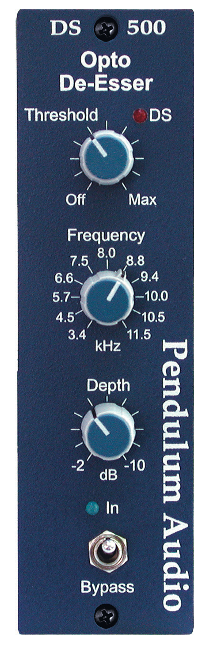
DS-500
Several other Pendulum pieces caught my eye. Gualtieri has broken out the De-esser from his Quartet Tube Recording Channel and made it available in the API 500 format as the DS-500.
Pendulum SPS-1
There are many ways to record acoustic instruments with pickups. The Pendulum SPS-1 is a two-channel rack unit that offers an impressive array of controls. 

I've been very happy with the K&K Pure Western Mini in my D-28S Martin and my Martin Grand J-28LSE baritone with D-TAR Wavelength pickup and mic, using vintage Groove Tube Brick and Ditto, tube direct boxes, or the instrument input of my Millennia Media STT-1, but this gear does spark my interest. That's all for now, but there's a lot more to come. Please stay tuned and subscribe to this blog.
Technique, Inc. © Copyright 2015 All Rights Reserved
More at www.tyford.com

BTW, to anyone contemplating Blogger as a platform. I find it is very unreliable, buggy and a royal PITA. 

Monday, November 2, 2015

AES NYC 2015 A Journeyman's Wandering #01


Jacob Javits Convention Center
We arrived in NYC at Penn Station Friday around mid-day to attend the Audio Engineers Association 2015 Convention at the Javits Center on 11th Avenue. I wanted to stop by the B&H Superstore first. They are not open on Saturdays due to religious observances.

Having been tipped off by PR Maven Howard Sherman that "The Microphone Room" at B&H's NYC store had been designed by Walters Storyk Design Group, I was more than a little interested in seeing the space and what was in it. John and Beth have done many spectacular projects over the years. How would they approach a mic room in a retail establishment?

Note: B&H help make this blog possible, but most people who know me at all are aware that I don't blow smoke. Someone had mentioned to me in the past that B&H's 9th Ave. store was pretty amazing. It was on my way to the Javits Center. OK, fine, Show me.  

In most big box stores, the audio department takes a back seat to the other gear. I entered the store and asked for the audio department was. I can't tell you how many square feet is deployed for audio, but it's SIZABLE. Aisles and aisles of glittering glass cases with mixers, headphones, recorders, mics, adapters, wind filters - all things audio, all JUST THERE in plain sight.

Impressive, but what about the microphone room? I was directed to it. Through the window I could see there were already people inside. You need to swipe a card to get into the room. I waited until the customers and B&H associate came out. I introduced myself and asked to see the room and was swiped in.


The space was a lot smaller than I expected, but the design was obvious - no parallel walls. Thick walls to keep the "walla" from the rest of the store out and windows to allow the mics to be seen and to keep those in the room from becoming claustrophobic. As the heavy door "smffed" closed, the room was very quiet.

I was flanked on both sides by double arrays of microphones - two long brackets ran the length of each wall and the mics were attached on their various mic clips and suspension mounts to the brackets. Not under glass, behind a counter, but nekkid and staring you in the face where you can touch them, fondle them or handle them to see which have controls and what the controls are. 


B&H Microphone Room Wall #1

Large, medium and small condensers, shotguns, dynamics, ribbons. OK, a massive display, but what about hearing them? As you can see from the shot below, there seems to be some rack mounted gear under the array on wall #2.

B&H Microphone Room Wall #2
And a closer look reveals a credenza full of preamps and a patchbay that lets you hear and compare each to these mics. You can click on each photo to see the gear in greater detail.


I suppose there might be another retail showroom that has this sort of display, but I've never seen or heard of one. Kudos to B&H for putting it out there like this for gear slutting audio people. If you are within traveling distance from NYC and are trying to make choices about microphones, it's hard to beat the idea of a road trip to this "oasis or microphones." Bring your favorite set of headphones so you can make good comparative decisions.

Oh, by the way, the audio monitor room was the next one over. Here's a peek.


I'll be posting info from booth visits on the AES Display Floor. Stay tuned! Copyright 2015 © Technique, Inc. All Rights Reserved
More at www.tyford.com


Monday, September 7, 2015

DPA Boom Mics - 4017 and 4018 with MMP-B and MMP-C Preamps


DPA manufactures a wide variety of microphones for live sound, studio recording and location audio. I had seen some recent comments about the DPA 4017 short shotgun and 4018 supercardioid for location audio. I reached out to the US office in Longmont, CO, just north of Denver, and arranged to have them sent in for a look and listen. 

These are part of a modular system of electret mics. Don’t be scared off by the word “electret.” Science and technology have proven that electret mics with internal polarization, can be designed to sound as good as externally polarized “true condenser” mics. I think the term “true condenser” was created by a marketing department to differentiate its own externally polarized mics and cast a bit of shade on the competition. if you're not a true condenser, what are you? A false condenser?

DPA stands for Danish Professional Audio. According to James Capparelle, DPA Marketing Coordinator and Product Specialist for the US office, "In 1992 two employees took the Brüel & Kjær measurement technology and started DPA to make microphones. B&K still exists. DPA still orders the original omnidirectional 4006 and 4007 "German Silver" membrane capsules from B&K." Both the 4006 and 4007 capsules can use any of the modular preamplifiers.

Mikkel Nymand
James Capparelle
"German Silver" actually contains no silver at all. According to DPA tonmeister Mikkel Nymand, "We have a few other capsules in our portfolio using an alloy called “German Silver”, consisting of copper, nickel and zinc. These are used in the legendary recording mics 4006 and 4007. The diaphragms in the 4017 and 4018 mics you have for test are mylar material with a gold layer. This design is used in the majority of our mics.

Nymand says other differences in DPA designs help to differentiate their mics from others. "Higher polarization voltage means higher sensitivity, lower self-noise and also higher distance between diaphragm and backplate, resulting in bigger dispersion of the diaphragm, and that equals higher SPL handling. You can’t achieve all this with a regular external P48V phantom power supply! The pre-polarization voltage is more than you have in your power outlet in the wall, it’s a company secret exactly how much, but I can say we are talking several hundreds volts."

The DPA modular system is comprised of three “preamps.” If you’re new to the field, these preamps do not replace the preamps in mixers or consoles you need to get the signal to line level for mixing. In this case, the preamp converts the very high impedance of the capsule into something a mic preamp wants to deal with. 
The DPA MMP-A, which I was not sent, is a .75” x 5.8” tube containing a transformerless preamp with a switchable 20 dB pad that requires 48 V DC Phantom Power and a power consumption of 2.8 mA. It has an 5 V RMS output voltage. It has a fixed -3dB cut at 8 Hz. 138 dB of dynamic range. The specs also mention that operation is stable up to 90% humidity. 

DPA MMP-B Preamp
The DPA MMP-B is a .75” x 3.9” tube containing a transformerless preamp that requires 48 V DC Phantom Power and a power consumption of 4.5 mA. It has a 1.8 V RMS output voltage. It has a nicely designed low cut and a high boost EQ. The low cut is a first order filter at 120 Hz and a fixed -3 dB filter at 50Hz. The high boost is a +4 dB with a corner at 8 kHz. 128 dB of dynamic range. It has the same humidity figure as the MMP-A.

DPA MMP-C Preamp
The DPA MMP-C is a .75” x 1.6” tube containing a transformerless preamp. At just over an inch and a half long and only 1.4 oz in weight, it’s perfectly suited for long boom extensions where weight quickly multiplies. It requires 48 V DC Phantom Power and draws 2.8 mA. It has a 4 V RMS output voltage and a fixed 3dB cut at 15Hz. 136 dB dynamic range. It has the same humidity figure as the MMP-A. DPA says the MMP-C has a slightly softer or warmer character than the other preamps. I could hear a slight difference. Having read the data sheet that describes the difference as "softer", I'll go with warmer, but subtly so.

Please note that all of these mics require 48 V DC Phantom Power. There are some mixers that only provide 12 or 24 V DC Phantom Power. They will struggle to power these mics and the downside is typically distortion because the mics are starved for power. Some mixers' specs indicate that they provide 48 V DC Phantom Power, but their total amperage capability may not be sufficient to properly power more than one or two mics. A setup consisting of a dozen MMP-B preamps (@ 4.5 mA each), for example, would draw considerably more current than a dozen MMP-C preamps (@ 2.8 mA each). So, Phantom Power is about voltage and current, not just voltage.

Most of us have probably heard stories of how high humidity causes noise to be generated by condenser mics. Sometimes, but not always, this is due to moisture that condenses on the microphone diaphragm, either due to very high humidity, or by moving the mic from a very hot and humid area into a much cooler area where moisture condenses on the diaphragm and creates a path for voltage to leak across the diaphragm. 

Noise can also result when dirt builds up on the contacts between the capsule and the preamp. Summer gets pretty humid in the Mid-Atlantic US. I found that leaving the capsules connected to the preamps instead of unscrewing them and storing them separately pretty much eliminated the noise problems on my Schoeps modular mic system. 

There are also the DPA MMP-ER (rear cable) and MMP-ES (side cable) Modular Active Cables. They are for hanging mics or low-profile table or instrument mics. Both use the same circuitry as the C preamp and feature a split into a 12mm housing and a 3-pin XLR connector. These components attach the capsule to a cable at a length of 3 meters or optionally up to 30 meters. 
IN THE STUDIO
Please check out the videos and subscribe to my YouTube Channel. I made these videos so you could hear what these mics and features sound like and compare them. As you watch and listen to the clips, remember that this is compressed Youtube audio, not full 24-bit, 48 kHz audio. Also, lap top or smart phone speakers aren’t a great way to make judgements about audio. To better understand what's going on, please use good headphones or studio monitors.

My studio is quiet and well damped. That means that any mic sounds as good as it can because of fewer reflections. It does however allow a very good environment to hear what each mic and combination sounds like. With the MMP-B, MMP-C, 4017 short shotgun capsule and 4018 supercardioid capsule in my studio, I was very happy with the sound of all the combinations. With all of my switching and swapping, the resultant combinations still sounded like they all came from the same family. 
I particularly like the design of the EQ controls on the MMP-B  The low cut and high boost EQ are well designed, easy to read and somewhat subtle, but effective. The MMP-C has no controls and neither do the 4017 short shotgun and 4018 supercardioid capsules. 


IN THE GREEN ROOM
For the comparison between the 4018C and CMC641, I chose a more typical location with some room reflection. 


To my ears, the MMP-C preamp and 4018 supercardioid capsule, seen online as the DPA 4018C sounds very similar to the Schoeps CMC641 and at this moment, it’s priced slightly higher than the CMC641. $1,710 for the DPA versus $1,622 for the Schoeps.

Making a supercardioid capsule is easier than making one that has as small a back lobe as possible and that has uniform frequency response as the sound source moves off axis. These changes in frequency response can be heard as slight irregularities or beaminess of certain frequencies. My Schoeps CMC641 is very good. As a person speaking moves off axis, it sounds like someone turned the pot down. Their voice fades away very evenly. The DPA 4018 supercardioid responds similarly. 

I asked Nymand about the axial response of the 4018 supercardioid capsule. "The tighter you want the side response, the more you move towards the figure-of-eight characteristic (including that the rear lobe will be in opposite phase). But exactly how much this rear lobe is present is where the R&D hours are spent. The secrets lie within the physical/acoustic design within the capsule and the rear entrance port. Do remember, any cardioid/supercardioid may not be cardioid/supercardioid at all frequencies. it’s very easy for manufacturers not paying the attention to detail as we do to claim they have a certain type, but it’s not always the case."


DPA 4018 Supercardioid Capsule


Next is the DPA 4017 short shotgun. Like the 4018, the capsules and preamps are light weight, making booming a lot easier. As demonstrated in the video, the 4017 holds it's own among the other shotgun mics and the CMC641.

With interference tube mic, you have to balance the increased distance from the sound source due to the sheer length of the interference tube against what benefit it might provide. The interference tube and capsule of the DPA4017C  account for only 4.5 inches of the total 6.1 inch length. 

While that's short enough to mount on many DSLR cameras, please don't expect great results with any camera-mounted microphones. Shotgun mics do not allow you to crop out the noise the way a zoom lens allows you to zoom in. When using microphones, getting as close as possible to the intended sound source is always your best strategy. 

Interference tube mics are great in controlled sound environments, (Think QUIET ON THE SET!) especially when that controlled environment also limits or covers hard, flat, reflective surfaces. As directional as interference tube mics are for high frequencies, they are not so directional at middle and low frequencies. If, for example, you have ambient noise such as traffic, a busy retail space, a kitchen with cabinet doors and counter tops with a lot of hard flat surfaces like pavement, buildings, walls, ceilings, counters or windows, the better choice may be the supercardioid 4018.

DPA 4017 Shotgun capsule
Another thing I like about these capsules is that there's just enough lift in the high frequencies to add clarity and intelligibility, but not enough to cause that irritating "skritch" heard so frequently with cheaper mics.

All combinations of preamps and capsules combine well and produce very high quality results. In addition they are very light weight. If you do a lot of booming for location audio work, you'll appreciate this immediately and at the end of the day.

Technique, Inc. © Copyright 2015 All Rights Reserved.
www.tyford.com

Please consider subscribing to my blog.

Thursday, August 6, 2015

Audacity - Clunky, But Extremely Helpful!

I’ve been using Pro Tools for over a decade and a half. I make a good part of my living with Pro Tools on any number of Macs. And yes, I admit it. I have not been very kind to Audacity. I tried it and found it clunky. Yesterday, however, changed my opinion of Audacity.
Download Audacity Here - http://audacityteam.org
I received an email from a Google account executive in California. It wasn’t a pitch. He had found me by googling some words about restoring or saving audio. I guess that means that my present SEO strategy is working.

He had recorded audio during several meetings on his cell phone; a great way to keep track of what was said. Unfortunately, as his email explained, on these three meetings something happened and the .wav files could not be opened or even played. He said he would pay me to open them. I told him that I would try, but with no promise of success. 

Import Raw Data
I opened a folder in DropBox and sent him the link. He does not have a DropBox Account. I tried the “collaborate” link first but he said this made DropBox ask him to join. I then sent him the simple “share” feature. That worked. He forwarded the files. I tried opening them with all of my apps; Pro Tools, QT, VLC, Soundtrack Pro and Audition. Even Sound Devices Wave Agent was powerless. Then I remembered that Audacity had an “Import Raw Data” feature. 

I didn’t have Audacity on my computer. I downloaded the latest version (2.1.1) from the web site, http://audacityteam.org. Using the Import Raw Audio feature, I was easily able to bring up the first file in stereo to the time line. One track was solid noise. The other looked like it might have been someone talking. 

Choosing A Different Sample Rate
I used the Audacity menu option to split the stereo track into two mono tracks. Then I clicked on the “M” mute button on the track that looked like noise. 

When I hit play, I head voice, but at the wrong speed. I used the sample rate menu to change the playback to a different sample rate. A short trial and error period later, I found the correct sample rate and the voice track was ready to export. 

I swept my cursor over the track and used Export Selected Audio. A window popped up with half a dozen or so fields to plug values into. I ignored them, but chose the same folder as the original files for a destination. I then added “fixed” to the file name and hit return. Within seconds the file popped up in the folder. When I clicked on the fixed file, the iTunes opened the file and the audio was there. Great!

The second file was even easier. It came up as a stereo file with both tracks playable, but at the wrong speed. I adjusted the sample rate and quickly found success. I appended the name of the file, exported the selected audio and checked the file in iTunes. Another success.

When I used the Import Raw Data on the third file, it came up as a mono file but, again, the wrong speed. A quick sample rate adjustment and it sounded fine. Append name, Export, Check iTunes, Done!

I then moved the three fixed files back to the Dropbox folder and called my new client. He was very grateful. I sent him a request for payment from my PayPal account and even though he did not have a PayPal account he was able to respond and two hours later I received an email notice from PayPal that I had been paid.

I also forwarded a link to my review of the Sony M10 pocket recorder; a very easy to use, compact recorder that will work even better than his smart phone.

So. Thank you Audacity for having a feature that allowed me to go audio fishing in your pond and make an additional billable hour and thank you Google for finding me in a vast universe of people who do things with audio. 

Technique, Inc. © Copyright 2015 All Rights Reserved
More at http://www.tyford.com