DPA manufactures a wide variety of microphones for live sound, studio recording and location audio. I had seen some recent comments about the DPA 4017 short shotgun and 4018 supercardioid for location audio. I reached out to the US office in Longmont, CO, just north of Denver, and arranged to have them sent in for a look and listen.
These are part of a modular system of electret mics. Don’t be scared off by the word “electret.” Science and technology have proven that electret mics with internal polarization, can be designed to sound as good as externally polarized “true condenser” mics. I think the term “true condenser” was created by a marketing department to differentiate its own externally polarized mics and cast a bit of shade on the competition. if you're not a true condenser, what are you? A false condenser?
DPA stands for Danish Professional Audio. According to James Capparelle, DPA Marketing Coordinator and Product Specialist for the US office, "In 1992 two employees took the Brüel & Kjær measurement technology and started DPA to make microphones. B&K still exists. DPA still orders the original omnidirectional 4006 and 4007 "German Silver" membrane capsules from B&K." Both the 4006 and 4007 capsules can use any of the modular preamplifiers.
 |
| Mikkel Nymand |
 |
| James Capparelle |
Nymand says other differences in DPA designs help to differentiate their mics from others. "Higher polarization voltage means higher sensitivity, lower self-noise and also higher distance between diaphragm and backplate, resulting in bigger dispersion of the diaphragm, and that equals higher SPL handling. You can’t achieve all this with a regular external P48V phantom power supply! The pre-polarization voltage is more than you have in your power outlet in the wall, it’s a company secret exactly how much, but I can say we are talking several hundreds volts."
The DPA modular system is comprised of three “preamps.” If you’re new to the field, these preamps do not replace the preamps in mixers or consoles you need to get the signal to line level for mixing. In this case, the preamp converts the very high impedance of the capsule into something a mic preamp wants to deal with.
The DPA MMP-A, which I was not sent, is a .75” x 5.8” tube containing a transformerless preamp with a switchable 20 dB pad that requires 48 V DC Phantom Power and a power consumption of 2.8 mA. It has an 5 V RMS output voltage. It has a fixed -3dB cut at 8 Hz. 138 dB of dynamic range. The specs also mention that operation is stable up to 90% humidity.
 |
| DPA MMP-B Preamp |
 |
| DPA MMP-C Preamp |
The DPA MMP-C is a .75” x 1.6” tube containing a transformerless preamp. At just over an inch and a half long and only 1.4 oz in weight, it’s perfectly suited for long boom extensions where weight quickly multiplies. It requires 48 V DC Phantom Power and draws 2.8 mA. It has a 4 V RMS output voltage and a fixed 3dB cut at 15Hz. 136 dB dynamic range. It has the same humidity figure as the MMP-A. DPA says the MMP-C has a slightly softer or warmer character than the other preamps. I could hear a slight difference. Having read the data sheet that describes the difference as "softer", I'll go with warmer, but subtly so.
Please note that all of these mics require 48 V DC Phantom Power. There are some mixers that only provide 12 or 24 V DC Phantom Power. They will struggle to power these mics and the downside is typically distortion because the mics are starved for power. Some mixers' specs indicate that they provide 48 V DC Phantom Power, but their total amperage capability may not be sufficient to properly power more than one or two mics. A setup consisting of a dozen MMP-B preamps (@ 4.5 mA each), for example, would draw considerably more current than a dozen MMP-C preamps (@ 2.8 mA each). So, Phantom Power is about voltage and current, not just voltage.
Most of us have probably heard stories of how high humidity causes noise to be generated by condenser mics. Sometimes, but not always, this is due to moisture that condenses on the microphone diaphragm, either due to very high humidity, or by moving the mic from a very hot and humid area into a much cooler area where moisture condenses on the diaphragm and creates a path for voltage to leak across the diaphragm.
Noise can also result when dirt builds up on the contacts between the capsule and the preamp. Summer gets pretty humid in the Mid-Atlantic US. I found that leaving the capsules connected to the preamps instead of unscrewing them and storing them separately pretty much eliminated the noise problems on my Schoeps modular mic system.
Noise can also result when dirt builds up on the contacts between the capsule and the preamp. Summer gets pretty humid in the Mid-Atlantic US. I found that leaving the capsules connected to the preamps instead of unscrewing them and storing them separately pretty much eliminated the noise problems on my Schoeps modular mic system.
There are also the DPA MMP-ER (rear cable) and MMP-ES (side cable) Modular Active Cables. They are for hanging mics or low-profile table or instrument mics. Both use the same circuitry as the C preamp and feature a split into a 12mm housing and a 3-pin XLR connector. These components attach the capsule to a cable at a length of 3 meters or optionally up to 30 meters.
IN THE STUDIO
Please check out the videos and subscribe to my YouTube Channel. I made these videos so you could hear what these mics and features sound like and compare them. As you watch and listen to the clips, remember that this is compressed Youtube audio, not full 24-bit, 48 kHz audio. Also, lap top or smart phone speakers aren’t a great way to make judgements about audio. To better understand what's going on, please use good headphones or studio monitors.
My studio is quiet and well damped. That means that any mic sounds as good as it can because of fewer reflections. It does however allow a very good environment to hear what each mic and combination sounds like. With the MMP-B, MMP-C, 4017 short shotgun capsule and 4018 supercardioid capsule in my studio, I was very happy with the sound of all the combinations. With all of my switching and swapping, the resultant combinations still sounded like they all came from the same family.
My studio is quiet and well damped. That means that any mic sounds as good as it can because of fewer reflections. It does however allow a very good environment to hear what each mic and combination sounds like. With the MMP-B, MMP-C, 4017 short shotgun capsule and 4018 supercardioid capsule in my studio, I was very happy with the sound of all the combinations. With all of my switching and swapping, the resultant combinations still sounded like they all came from the same family.
I particularly like the design of the EQ controls on the MMP-B The low cut and high boost EQ are well designed, easy to read and somewhat subtle, but effective. The MMP-C has no controls and neither do the 4017 short shotgun and 4018 supercardioid capsules.
IN THE GREEN ROOM
For the comparison between the 4018C and CMC641, I chose a more typical location with some room reflection.
To my ears, the MMP-C preamp and 4018 supercardioid capsule, seen online as the DPA 4018C sounds very similar to the Schoeps CMC641 and at this moment, it’s priced slightly higher than the CMC641. $1,710 for the DPA versus $1,622 for the Schoeps.
I asked Nymand about the axial response of the 4018 supercardioid capsule. "The tighter you want the side response, the more you move towards the figure-of-eight characteristic (including that the rear lobe will be in opposite phase). But exactly how much this rear lobe is present is where the R&D hours are spent. The secrets lie within the physical/acoustic design within the capsule and the rear entrance port. Do remember, any cardioid/supercardioid may not be cardioid/supercardioid at all frequencies. it’s very easy for manufacturers not paying the attention to detail as we do to claim they have a certain type, but it’s not always the case."

 |
| DPA 4018 Supercardioid Capsule |
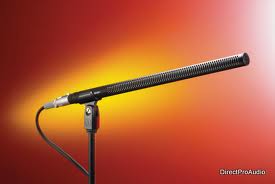
Next is the DPA 4017 short shotgun. Like the 4018, the capsules and preamps are light weight, making booming a lot easier. As demonstrated in the video, the 4017 holds it's own among the other shotgun mics and the CMC641.
With interference tube mic, you have to balance the increased distance from the sound source due to the sheer length of the interference tube against what benefit it might provide. The interference tube and capsule of the DPA4017C account for only 4.5 inches of the total 6.1 inch length.
While that's short enough to mount on many DSLR cameras, please don't expect great results with any camera-mounted microphones. Shotgun mics do not allow you to crop out the noise the way a zoom lens allows you to zoom in. When using microphones, getting as close as possible to the intended sound source is always your best strategy.
Interference tube mics are great in controlled sound environments, (Think QUIET ON THE SET!) especially when that controlled environment also limits or covers hard, flat, reflective surfaces. As directional as interference tube mics are for high frequencies, they are not so directional at middle and low frequencies. If, for example, you have ambient noise such as traffic, a busy retail space, a kitchen with cabinet doors and counter tops with a lot of hard flat surfaces like pavement, buildings, walls, ceilings, counters or windows, the better choice may be the supercardioid 4018.
 |
| DPA 4017 Shotgun capsule |

All combinations of preamps and capsules combine well and produce very high quality results. In addition they are very light weight. If you do a lot of booming for location audio work, you'll appreciate this immediately and at the end of the day.
Technique, Inc. © Copyright 2015 All Rights Reserved.
www.tyford.com
Please consider subscribing to my blog.