Showing posts with label shotgun microphone. Show all posts

Thursday, April 16, 2015

Rode NTG4 and NTG4+ Shotgun Microphones - New Tools

Rode NTG4 & NTG4+
Rode continues it’s pursuit of the audio for video market with a new pair of shotgun mics; the NTG4 ($369) and NTG4+ ($399). They are basically identical except that the NTG4+ has a USB rechargeable Lithium Ion battery. 

The NTG4 runs off of 12 V, 24 V or 48 V Phantom Power, but the NTG4+ only runs off 48 V Phantom Power or its battery. That battery, when new, takes two hours to charge and runs for about 150 hours. You can charge it with any USB charger or a USB port on a computer.

This means you can use the NTG4+ with standard professional audio gear that supplies Phantom Power, or with cameras and devices that may not have Phantom Power. With 150 hours run time, you could shoot 24/7 for six days without recharging.

Note that not all Phantom Power supplies are the same. If your Phantom Power supply is only 12 V or 24 V and you try to use a mic that needs 48 V, it may work, but there will be some degree of distortion because you’re starving it. 

Rode tweeked the capsule or capsule response in these two new mics, rolling off a bit of the low end that their NTG1 and NTG2 capture. I don’t find it to be a problem. There are shotgun mics like the Shure VP 89 that are obviously designed for run and gun ENG work in very noisy environments. On that series, the low end is markedly rolled off. Not so much on the NTG4 and NTG4+. 

If you can't read the specs to the right, here's a link to the data sheet. 


Triple Treat

There are three buttons on the NTG4 and NTG4+; High Frequency Boost, Low Frequency Cut and -10dB Pad. The HF Boost feature is usually used when the mic is mounted in a blimp/zeppelin wind stopper to offset the high frequency loss caused by the fur and material. You could also operate with it on if you just liked the sound of the peaky response or if the person you’re micing has one of those really soft, dark voices that needs a little help.


And here's my hands-on demo so you can see and hear what the NTG4+ sounds like. Yes they have revoiced the capsule, relative to the NTG1 and NTG2. I like the change; a little tighter low end.


Both the NTG4 and NTG4+ come with the RM5 non-suspension mic clip, ZP2 padded storage pouch and foam windshield. The NTG4+ also includes the micro USB charging cable. 

Rode is big on support. Just register the NTG4 or NTG4+ at their web site and your new mic will be under warranty for ten years. 

Technique, Inc. © 2105 All Rights Reserved

Reach Ty Ford at www.tyford.com


Monday, December 23, 2013

Shure Triple Threat Shotguns


Shure VP89 L, M & S
The VP89/L, VP89/M and VP89/S are long, medium and short electret condenser shotguns from Shure. The bodies are charcoal-grey metallic painted aluminum alloy with a stainless steel screen. They require 11-52 V DC phantom power. Each interference tube capsule comes with and use its own Shure VP89 XLR-terminated power supply with high-pass filter. There is no pad.

Each mic comes in a handy and sturdy vinyl-clad hard tube holster that’s large enough to accept the mic with its included foam wind filter. If more wind protection is required, Shure has three sizes of pistol-grip based windshields, one for each length and a Rycote Lyre suspension mount.

Monday, November 25, 2013

Rode NTG8 - The Big (Shot) Gun


The long shotgun microphone is something you don't see in a lot of kits. I have one, but haven't used it in years. But then most of my work is inside. I remember playing with the long shotgun soon after I got it to find out what it would give me. 

I was on the front lawn in a quiet neighborhood in Baltimore. A short block a way, across the street, one of my neighbors approached his car. This was back in the day when you had to unlock your car with a key. I put on the headphones, aimed the long gun at him and cranked the input on the mixer. To my great surprise, I head the tinkle of his keys. Then a car came up the street, driving between us. It would have deafened me had I not ejected the headphones straight off my head.

You see long shotguns outside in sports, nature and some feature film work when wireless lavs are frowned upon and wide shots have dialog. Not used as often as hypers or short shotguns, they remain part of the audio tool kit, along with the wind gear that's usually required to keep them happy.

Wednesday, January 9, 2013

Rode NTG-3 Shotgun Mic


NTG-3 and MKH 416 open for close inspection

A $699 USD street, the Australian-made Rode NTG-3 seems extremely well-placed for its price and performance. Like the Sennheiser 416, the NTG-3 is an RF-condenser that combines a somewhat sophisticated RF circuit with the capsule to reduce the deleterious effects of high humidity. Tricky to design, but worth the effort. That design element has contributed greatly to the 416ʼs “bullet proof” reputation and should do the same for the NTG-3.

FEATURES
The RF environment is growing significantly more hostile, though, and Rode seems to have taken shielding a bit farther than Sennheiser did back in 1974 when the MKH 416 came to market. Attention to the mechanical and electronic lay out of the NTG-3 including the surface mount technology (SMT), PCB layout, component selection and dual chamber design of the internal brass tube that appears to separate most of the circuitry from the tunable RF section and capsule, all contribute to RF resistance and mic performance. Sennheiser has also gone to SMT and other upgrades with all of their later model MKH 416 mics.

Wednesday, June 27, 2012

AT835ST AT815ST Are Now BP4029 and BP4027


Audio Technica BP4027
This review was written about the AT835ST and AT815ST. The models were changed slightly in 2007 before being renamed the BP4029 and BP4027, respectively. In the rapidly changing world of pro audio, taking things for granted is not a good idea. If you think you know what to expect from a stereo shotgun mic, you might accidentally dismiss Audio Technica’s 9-inch AT835ST ($899) and 15-inch AT815ST ($999) mics. 

Monday, April 23, 2012

Rode NTG-3 Shotgun Mic - Ready For Action


This Australian-made Rode NTG-3 microphone ($699) seems extremely well-placed for its price and performance. Like the Sennheiser 416, the NTG-3 is an RF-condenser unit that combines a somewhat sophisticated RF circuit with the capsule to reduce the deleterious effects of high humidity. It's tricky to design, but worth the effort. That design element has contributed greatly to a "bullet proof" reputation for similar mics and should do the same for the NTG-3. 

Sunday, March 25, 2012

Sanken CS-1 Short Shotgun -- But Is It A Shotgun??


Sanken CS-1e
The Sanken CS-1, and for that matter the Sanken CS-3, were both modified shortly after they came out. The new versions are the CS-1e and CS-3e. It's been some time, but I recall the modification had to do with lowering the noise figure on each mic.

Saturday, March 3, 2012

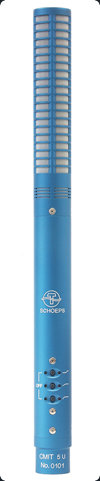
Schoeps CMIT Analog Shotgun Mic


Schoeps CMIT Analog Shotgun
Yes, there is now a Schoeps Digital shotgun mic. But this analog version came first in 2005 after some arm twisting and it's a great sounding mic. I'll post my review of the digital SuperCMIT later.

Imagine the surprise of shotgun mic users everywhere to find that Schoeps finally caved after twenty years and made a shotgun microphone. At the 2005 New York AES Convention, there it was, in blue anodized aluminum. No other mic on the planet looks like it so they get marketing marks for that alone. What took them so long? What are the implications? What are the features? How does it sound? We can only guess what changed their mindset from, “We don’t want/need to.”